Allah

Allah
Showing posts with label Azkar. Show all posts

Mar 2, 2011

The excellence of remembering Allah :


254. Allah's Messenger (SAW) said: Whoever says:

Subhaanallaahi wa bihamdihi.

Glorified is Allah and praised is He.

one hundred times a day, will have his sins forgiven even if they are like the foam of the sea.

Reference: Al-Bukhari 7/168, Muslim 4/2071, see also invocation no. 91 of this book.

255. Allah's Messenger (SAW) said: Whoever says:

Laa 'ilaaha 'illallaahu wahdahu laa shareeka lahu, lahul-mulku wa lahul-hamdu wa Huwa 'alaa kulli shay'in Qadeer.

None has the right to be worshipped but Allah alone, Who has no partner. His is the dominion and His is the praise, and He is Able to do all things.

ten times, will have the reward for freeing four slaves from the Children of Isma'il.

Reference: Al-Bukhari 7/67, Muslim 4/2071, see also invocation no. 93 of this book.

256. Allah's Messenger (SAW) said: Two words are light on the tongue, weigh heavily in the balance, and are loved by the Most Merciful One:

Subhaanal-laahi wa bihamdihi, Subhaanal-laahil-'Adheem.

Glorified is Allah and praised is He , Glorified is Allah the Most Great.

Reference: Al-Bukhari 7/168, Muslim 4/2072.

257. Allah's Messenger (SAW) said: For me to say:

Subhaanallaahi, walhamdu lillaahi, wa laa 'ilaaha 'illallaahu, wallaahu 'Akbar.

Glory is to Allah, and praise is to Allah, and there is none worthy of worship but Allah, and Allah is the Most Great.

is dearer to me than all that the sun rises upon (i.e. the whole world).

Reference: Muslim 4/2072.

258. Allah's Messenger (SAW) said:

"Is anyone of you incapable of earning one thousand Hasanah (rewards) in a day?" Someone from his gathering asked, "How can anyone of us earn a thousand Hasanah':'" He said, "Glorify Allah a hundred times and a thousand Hasanah will be written for you, or a thousand sins will be wiped away."

Reference: Muslim 4/2073.

259. Whoever says:

Subhaanallaahil-'Adheemi wa bihamdihi.

Glorified is Allah the Most Great and praised is He.

will have a date palm planted for him in Paradise.

Reference: At-Tirmithi 5/511, and Al-Hakim who graded it authentic and Ath-Thahabi agreed 1/501. See also Al-Albani, Sahihul-Jami' As-Saghir 5/531 and Sahih At-Tirmithi3/160.

260. Allah's Messenger (SAW) said: "O Abdullah bin Qais, should I not point you to one of the treasures of Paradise?" I said, "Yes, O Messenger of Allah." So he told me to say:

Laa hawla wa laa quwwata 'illaa billaah.

There is no power and no might except by Allah.

Reference: Al-Bukhari, cf. Al-Asqalani, Fathul-Bari 11/213, Muslim 4/2076.

261. Allah's Messenger (SAW) said: The most beloved words to Allah are four:

Subhaanallaah, Walhamdu lillaah, Wa laa 'ilaaha 'illallaah and Wallaahu 'Akbar.

Glorified is Allah, The praise is for Allah, There is none worthy of worship but Allah, Allah is the Most Great

Reference: Muslim 3/1685.

262. A desert Arab came to Allah's Messenger (SAW) and said, "Teach me a word that I can say. " The Prophet told him to say:

Laa 'ilaaha 'illallaahu wahdahu laa shareeka lahu, Allaahu 'Akbaru kabeeran, walhamdu lillaahi katheeran, Subhaanallaahi Rabbil-'aalameen, laa hawla wa laa quwwata 'illaa biilaahil-'Azeezil-Hakeem.

There is none worthy of worship but Allah , Who has no partner, Allah is the Great, the Most Great, and praise is to Allah in abundance, glory is to Allah, Lord of the worlds . There is no power and no might but by Allah the Mighty, the Wise.

He said, "That is for my Lord, but what about me?" The Prophet (SAW) told him to say:

Allaahummaghfir lee, warhamnee, wahdinee warzuqnee

O Allah forgive me, and have mercy on me and guide me, and provide for me.

Reference: Muslim 4/2072, Abu Dawud reports the same Hadith with the addition: and when the Arab left, the Prophet (SAW) said: "He has filled his hands with goodness." 1/220.

263. Whenever anyone accepted Islam, the Prophet (SAW) used to teach him how to pray then he would instruct him to invoke Allah with the following words:

Allaahummaghfir lee, warhamnee, wahdinee, wa 'aafinee warzuqnee.

O Allah forgive me, and have mercy on me and guide me and give me good health and provide for me.

Reference: Muslim 4/2073, and in one of Muslim's reports there is the addition: 'For these words combine [the goodness of] this world and the next.'

264. The most excellent invocation is:

Alhamdu lillaah.

Praise is for Allah.

Laa'ilaaha'illallaah.

There is none worthy of worship but Allah.

Reference: At-Tirmithi 5/462, Ibn Majah 2/1249, and Al-Hakim who graded it authentic and Ath-Tbahabi agreed 1/503. See Al-Albani, Sahihul-Jami' As-Saghir 1/362.

265. The good deeds which endure are:

Subhaanallaah, Walhamdu lillaah, Wa laa 'ilaaha 'illallaah, Wallaahu 'Akbar and Wa laa hawla wa laa quwwata 'illaa billaah

Glorified is Allah, The praise is for Allah, There is none worth of worship but Allah, Allah is the Most Great and There is no power and no might except by Allah

Reference: Ahmad (no. 513) (Ahmad Shakir, ed.) and its chain of narration is authentic. See Majma'uz-Zawa'id 1/297. Ibn Hajar mentions it in Bulughul-Maram saying that Ibn Hibban and Al-Hakim considered it authentic.

Repentance and seeking forgiveness:


248. Allah's Messenger (SAW) said: "By Allah, I seek the forgiveness of Allah, and repent to Him more than seventy times in a day.

Reference: Al-Bukhari, cf. Al-Asqalani, Fathul-Bari 11/101.

249. Allah's Messenger (SAW) said: "O people, repent to Allah, for I verily repent to Him one hundred times a day.

Reference: Muslim 4/2076.

250. Allah's Messenger (SAW) said: Whoever says:

'Astaghfirullaahal-'Adheemal-lathee laa 'ilaaha 'illaa Huwal-Hayyul-Qayyoomu wa 'atoobu 'ilayhi.

I seek the forgiveness of Allah the Mighty, Whom there is none worthy of worship except Him, the Living, the Eternal, and I repent to Him, Allah will forgive him even if he has deserted the army's ranks.

Reference: Abu Dawud 2/85, At-Tirmithi 5/569, and Al-Hakim who declared it authentic and Ath-Thahabi agreed with him 1/511. Al-Albani graded it authentic in Sahih At-Tirmithi 3/182. See also Jami'ul-'Usool li-'Ahdaith Ar-Rasool 4/ 389-90 checked by Al-Arna'ut.

251. Allah's Messenger (SAW) said: "The closest that the Lord comes to the slave is in the last portion of the night. So, if you are able to be among those who remember Allah in this hour, then be among them."

Reference: At-Tirmithi, An-Nasa'i 1/279 and Al-Hakim. See also Al-Albani, Sahih At-Tirmithi 3/183, and Jdmi'ul-'Usool with Al-Arna'ut's checking 4/144.

252. Allah's Messenger (SAW) said: "The closest that the slave comes to his Lord is when he is prostrating, so invoke Allah much (in prostration)."

Reference: Muslim 1/350.

253. Allah's Messenger (SAW) said: "It is a heavy thing for my heart if I do not seek Allah's forgiveness a hundred times a day."

Reference: Muslim 4/2075. Ibn 'Athir explains that the Prophet (SAW) was always vigilant in his remembrance and drawing near to Allah, and if he forgot to do any of what he normally did from time to time, or it slipped his mind, he felt as if he had wronged himself and so he would begin to seek the forgiveness of Allah. See Jami'ul-'Usool 4/386.

Invocations :

What to say when slaughtering or sacrificing an animal

246. Bismillaahi wallaahu 'Akbar [Allaahumma minka wa laka] Allaahumma taqabbal minnee.

With the Name of Allah, Allah is the Most Great! [O Allah, from You and to You.] O Allah, accept it from me.

Reference: Muslim 3/ 1557, Al-Bayhaqi 9/287.

What to say to foil the devil's plots

247. 'A'oothu bikalimaatil-laahit-taammaatil-latee laa yujaawizuhunna barrun wa laa faajimn min sharri maa khalaqa, wa bara'a wa thara'a, wa min sharri maa yanzilu minas-samaa'i, wa min sharri maa ya'ruju feehaa, wa min sharri maa thara'a fil-'ardhi, wa min sharri ma yakhruju minhaa, wa min sharri fitanil-layli wannahaari, wa min sharri kulli taariqin 'illaa taariqan yatruqu bikhayrin yaa Rahmaan.

I seek refuge in the Perfect Words of Allah -which neither the upright nor the corrupt may overcome - from the evil of what He created, of what He made, and of what He scattered, from the evil of what descends from the heavens, and of what rises up to them, from the evil of what He scattered in the earth and of what emerges from it, from the evil trials of night and day, and from the evil of every night visitor, except the night visitor who comes with good. O Merciful One.

Reference: Ahmad 3/419, with an authentic chain of narration, and Ibn As-Sunni (no. 637). Al-Arna'ut, graded its chain authentic in his checking of Al-'Aqidah At-Tahawiyyah p. 133. See also Majma'uz-Zawa'id, 10/127.

Invocations :

What to say when surprised or startled

240. Subhaanallaah!

(Glory is to Allah).

Reference: Al-Bukhari, cf. Al-Asqalani, Fathul-Bari 1/210, 390, 414 and Muslim 4/1857.

241. Allaahu 'Akbar!

(Allah is the Most Great)

Reference: Al-Bukhari, cf. Al-Asqalani, Fathul-Bari 8/441. See also Al-Albani, Sahih At-Tirmithi 2/103, 235, Ahmad 5/218.

What to say when something that pleases you happens

242. Whenever something happened that pleased him or made him happy , the Prophet if! used to prostrate himself in thanks to Allah, the Blessed, the All-Mighty.

Reference: Abu Dawud, Ibn Majah, At-Tirmithi. See also Al-Albani, Sahih Ibn Majah 1/233, and 'Irwa'ul-Ghalil 2/226.

What to say when you feel a pain in your body

243. Put your hand on the place where you feel pain and say:

Bismillaah.

With the Name of Allah (three times).

Then say :

'A'oothu billaahi wa qudratihi min sharri maa 'ajidu wa 'uhaathiru.

I seek refuge in Allah and in His Power from the evil of what I find and of what I guard against.

Reference: Muslim 4/1728.

What to say when you fear you may afflict something with the evil eye

244. If you see anything of your brother that pleases you, or of his person or of his property [then ask Allah to bless him in it] for the envious eye is real.

Reference: Ahmad 4/447, Ibn Majah, Malik. Al-Albani graded it authentic in Sahihul-Jami' As-Saghir 1/212. Also see Al-Arna'ut's checking of Ibn Al-Qayyim's Zadul-Ma'ad 4/170.

What to say when you feel frightened

245. Laa 'ilaaha 'illallaah!

There is none worthy of worship but Allah!

Reference: Al-Bukhari, cf. Al-Asqalani, Fathul-Bari 6/181, Muslim 4/2208.

Invocations for Hajj or ‘Umrah:

The pilgrim's announcement of his arrival for Hajj or 'Umrah

233. Labbayk Allaahumma labbayk, labbayk laa shareeka laka labbayk, 'innal-hamda, wanni'mata, laka walmulk, laa shareeka laka.

I am here at Your service , O Allah , I am here at Your service. I am here at Your service, You have no partner, I am here at Your service . Surely the praise , and blessings are Yours , and the dominion . You have no partner.

Reference: Al-Bukhari, cf. Al-Asqalani, Fathul-Bari 3/408, Muslim 2/841.

Saying Allahu 'Akbar when passing the Black Stone

234. The Prophet (SAW) performed Tawaf riding a camel. Every time he passed the corner (containing the Black Stone), he would point to it with something that he was holding and say: Allaahu 'Akbar (Allah is the Most Great)!

Reference: Al-Bukhari, cf. Al-Asqalani, Fathul-Bari 3/476. See also 472. The 'something' that was referred to in this Hadith was a cane.

Invocation to be recited between the Yemenite Corner and the Black Stone

235. Rabbanaa 'aatinaa fid-dunyaa hasanatan wa fil-'aakhirati hasanatan wa qinaa 'athaaban-naar.

Our Lord, grant us the good things in this world and the good things in the next life and save us from the punishment of the Fire.

Reference: Abu Dawud 2/179, Ahmad 3/411, Al-Baghawi, Sharhus-Sunnah 7/128. Al-Albani graded it good in Sahih Abu Dawud 1/354. The Ayat is from Surat Al-Baqarah, 2:201.

Invocation to be recited while standing at Safa and Marwah

236. Whenever the Prophet (SAW) approached Mount Safa, he would recite:

'Innas-Safaa wal-Marwata min sha'aa'irillaah. 'Abda'u bimaa bada'allaahu bihi.

Surely Safa and Marwah are among the signs of Allah. I begin by that which Allah began.

He began (his Sa'y) at Mount Safa climbing it until he could see the House. He then faced the Qiblah repeating the words:

Laa 'ilaaha 'illallaah, Allaahu 'Akbar

There is none worthy of worship but Allah, and Allah is the Most Great.

Then he said:

Laa 'ilaaha 'illallaahu wahdahu laa shareeka lahu, lahul-mulku wa lahul-hamdu wa Huwa 'alaa kulli shay'in Qadeer, laa 'ilaaha 'illallaahu ilahaahu, 'anjaza wa'dahu, wa nasara 'abdahu, wa hazamal 'ahzaaba wahdahu.

None has the right to be worshipped but Allah alone, Who has no partner, His is the dominion and His is the praise, and He is Able to do all things . None has the right to be worshipped but Allah alone, He fulfilled His Promise, He aided His slave, and He alone defeated Confederates.

Then he would ask Allah for what he liked, repeating the same thing like this three times . He did at Mount Marwah as he did at Mount Safa.

Reference: Muslim 2/888.

Invocation to be recited on the Day of Arafat

The Prophet (SAW) said: The best invocation is that of the Day of Arafat, and the best that anyone can say is what I and the Prophets before me have said:

237. Laa 'ilaaha 'illallaahu wahdahu laa shareeka lahu, lahul-mulku wa lahul-hamdu wa Huwa 'alaa kulli shay'in Qadeer.

None has the right to be worshipped but Allah alone, Who has no partner. His is the dominion and His is the praise, and He is Able to do all things.

Reference: At-Tirmithi. Al-Albani graded it good in Sahih At-Tirmithi 3/184, and also Silsilatul-'Ahadith As-Sahihah 4/6.

Supplication to be recited at the sacred area of Muzdalifah

238. The Prophet (SAW) rode his camel, Al-Qaswa', until he reached the sacred area (Al-Mash'aril-Haraam). Then he faced the Qiblah and invoked Allah, and repeatedly said the words: Allaahu 'Akbar (Allah is the Most Great), Allaahu 'Ahad (Allah is One) and Laa 'ilaaha 'illallaah (There is none worthy of worship but Allah). He remained stationary until the sky became yellow with the dawn, and then pressed on before sunrise.

Reference: Muslim 2/891.

Saying Allahu 'Akbar while stoning the three pillars at Mina

239. The Prophet (SAW) said Allaahu 'Akbar (Allah is the Most Great) with each pebble he threw at the three pillars. Then he went forward, stood facing the Qiblah and raised his hands and called upon Allah. That was after (stoning) the first and second pillar. As for the third, he stoned it and called out Allaahu 'Akbar with every pebble he threw, but when he was finished he left without standing at it (for supplications).

Reference: Al-Bukhari, cf. Al-Asqalani, Fathul-Bari 3/581, 3, 4, and Muslim

Mar 1, 2011

Invocations;

Invocation upon hearing the cock's crow or the bray of a donkey

228. When you hear the cock's crow, ask Allah for His favor upon you for surely it has seen an angel . When you hear the bray of a donkey, seek refuge in Allah from Satan, for surely it has seen a devil.

Reference: Al-Bukhari, cf. Al-Asqalani, Fathul-Bari 6/350, Muslim 4/2092.

Invocation upon hearing a dog barking in the night

229. When you hear a dog barking or a donkey braying in the night , then seek refuge in Allah from them , for surely they have seen what you see not.

Reference: Abu Dawud 4/327, Ahmad 3/306. Al-Albani graded it authentic in Sahih Abu Dawud 3/961.

Invocations:

What to say if something happens to please you or to displease you

218. When something happened that pleased him , the Prophet (SAW) used to say:

Alhamdu lillaahil-lathee bini'matihi tatimmus-saalihaat.

Praise is to Allah Who by His blessings all good things are perfected .

And if something happened that displeased him , he used to say :

Alhamdu lillaahi 'alaa kulli haal.

Praise is to Allah in all circumstances.

Reference: Ibn As-Sunni, 'Amalul-Yawm wal-Laylah, and Al-Hakim who graded it authentic 1/499. See also Al-Albani, Sahihul-Jami' As-Saghir 4/201.

Invocations :

Invocation for when your vehicle or mount begins to fail

210. Bismillaahi.

With the Name of Allah.

Reference: Abu Dawud 4/296. Al-Albani graded it authentic in Sahih Abu Dawud 3/941.

The traveler's invocation for the one he leaves behind

211. 'Astawdi'ukumul-laahal-lathee laa tadhee'u wadaa'i'uhu.

I leave you in the care of Allah , as nothing is lost that is in His care.

Reference: Ahmad 2/403, Ibn Majah 2/943. See also Al-Albani, Sahih Ibn Majah 2/133.

The resident's invocations for the traveler

212. 'Astawdi'ullaaha deenaka, wa 'amaanataka, wa khawaateema 'amalika.

I leave your religion in the care of Allah , as well as your safety, and the last of your deeds.

Reference: Ahmad 2/7, At-Tirmithi 5/499. See also Al-Albani, Sahih At-Tirmithi 2/155.

213. Zawwadakal-laahut-taqwaa, wa ghafara thanbaka , wa yassara lakal-khayra haythu maa kunta.

May Allah give you piety as your provision, forgive your sins, and make goodness easy for you wherever you are.

Reference: At-Tirmithi. See Al-Albani, Sahih At-Tirmithi, 3/155.

Glorifying and magnifying Allah on the journey

214. Jabir (RA), said: Whenever we went up a hill we would say Allaahu 'Akbar (Allah is the Most Great) and when we descended we would say Subhaanallaah (Glory is to Allah).

Reference: Al-Bukhari, cf. Al-Asqalani, Fathul-Bari 6/135.

The traveler's invocation at dawn

215. Sami'a saami'un bihamdillaahi wa husni balaa'ihi 'alaynaa. Rabbanaa saahibnaa, wa 'afdhil 'alaynaa 'aa'ithan billaahi minan-naar.

He Who listens has heard that we praise Allah for the good things He gives us. Our Lord, be with us and bestow Your favor upon us. I seek the protection of Allah from the Fire.

Reference: Muslim 4/2086, the meaning of sami'a saami'un (who listens has heard) is that 'a witness has witnessed our praise of Allah due to His blessings and favor upon us.' It could also be read samma'a saami'un, in which case it means 'one who has heard this statement of mine will convey it to another and he will say it as well.' This is due to the attention given to the Thikr (remembrance of Allah) and supplications made during the early morning hours. The meaning of his saying 'Our Lord, be with us and bestow Your favor upon us' is: 'Our Lord, protect us and guard us. Bless us with Your numerous bounties, and avert from us every evil.' See An-Nawawi, Sharh Sahih Muslim 17/39.

What to say upon returning from a journey

From every elevated point say Allaahu 'Akbar (Allah is the Most Great) three times and then recite:

217. Laa 'ilaaha 'illallaahu wahdahu laa shareeka lahu, lahul-mulku, wa lahul-hamdu, wa Huwa 'alaa kutti shay 'in Qadeer, 'aa'iboona, taa'iboona, 'aabidoona, lirabbinaa haamidoona, sadaqallaahu wa'dahu, wa nasara 'abdahu, wa hazamal-'ahzaaba wahdahu.

None has the right to be worshipped but Allah alone , Who has no partner . His is the dominion and His is the praise , and He is Able to do all things. We return repentant to our Lord, worshipping our Lord , and praising our Lord . He fulfilled His Promise, He aided His slave, and He alone defeated the Confederates.

Reference: Bukhari 7/163, Muslim 2/980. The Prophet (SAW) used to say this when returning from a campaign or from Hajj.

Invocation for entering a market


209. Laa 'ilaaha 'illallaahu wahdahu laa shareeka lahu, lahul-mulku wa lahul-hamdu, yuhyee wa yumeetu, wa Huwa hayyun laa yamootu, biyadihil-khayru, wa Huwa 'alaa kulli shay'in Qadeer.

None has the right to be worshipped but Allah alone, Who has no partner. His is the dominion and His is the praise. He brings life and He causes death, and He is living and does not die. In His Hand is all good, and He is Able to do all things.

Reference: At-Tirmithi 5/291, and Al-Hakim 1/538. Al-Albani graded it good in Sahih Ibn Majah 2/21 and Sahih At-Tirmithi 3/152.

Invocations:

Invocation for riding in a vehicle or on an animal

206. Bismillaah , Alhamdu lillaah . Subhaanal-lathee sakhkhara lanaa haathaa wa maa kunnaa lahu muqrineen. Wa 'innaa 'ilaa Rabbinaa lamunqaliboon . Alhamdu lillaah, alhamdu lillaah, alhamdu lillaah, Allaahu 'Akbar, Allaahu 'Akbar, Allaahu 'Akbar, subhaanakal-laahumma 'innee dhalamtu nafsee faghfir lee, fa'innahu laa yaghfiruth-thunooba 'illaa 'Anta.

With the Name of Allah . Praise is to Allah . Glory is to Him Who has provided this for us though we could never have had it by our efforts. Surely, unto our Lord we are returning. Praise is to Allah. Praise is to Allah. Praise is to Allah. Allah is the Most Great. Allah is the Most Great. Allah is the Most Great. Glory is to You. O Allah, I have wronged my own soul. Forgive me, for surely none forgives sins but You.

Reference: Abu Dawud 3/34, At-Tirmithi 5/501. See also Al-Albani, Sahih At-Tirmithi3/156.

Invocation for traveling

207. Allaahu 'Akbar, Allaahu 'Akbar, Allaahu 'Akbar, Subhaanal-lathee sakhkhara lanaa haathaa wa maa kunnaa lahu muqrineen. Wa 'innaa 'ilaa Rabbinaa lamunqaliboon. Allaahumma 'innaa nas'aluka fee safarinaa haathal-birrawattaqwaa, waminal-'amalimaa tardhaa, Allaahumma hawwin 'alaynaa safaranaa haathaa watwi 'annaa bu'dahu, Allaahumma 'Antas-saahibu fis-safari, walkhaleefatu fil-'ahli, Allaahumma 'innee 'a'oothu bika min wa'thaa'is-safari, wa ka'aabanl-mandhari, wa soo'il-munqalabi fil-maaliwal'ahli.

Allah is the Most Great. Allah is the Most Great. Allah is the Most Great. Glory is to Him Who has provided this for us though we could never have had it by our efforts. Surely, unto our Lord we are returning. O Allah, we ask You on this our journey for goodness and piety, and for works that are pleasing to You . O Allah , lighten this journey for us and make its distance easy for us . O Allah, You are our Companion on the road and the One in Whose care we leave our family . O Allah , I seek refuge in You from this journey's hardships, and from the wicked sights in store and from finding our family and property in misfortune upon returning.

(Upon returning recite the same again adding :)

'Aa'iboona, taa'iboona, 'aabidoona, Lirabbinaa haamidoon.

We return repentant to our Lord, worshipping our Lord, and praising our Lord.

Reference: Muslim 2/978.

Invocation for entering a town or city

208. Allaahumma Rabbas-samaawaatis-sab'i wa maa 'adhlalna, wa Rabbal-'aradheenas-sab'i wa maa 'aqlalna, wa Rabbash-shayaateeni wa maa 'adhlalna, wa Rabbar-riyaahi wa maa tharayna. 'As'aluka khayra haathihil-qaryati wa khayra 'ahlihaa, wa khayra maafeehaa, wa 'a'oothu bika min sharrihaa, wa sharri 'ahlihaa, wa shard maa feehaa.

O Allah, Lord of the seven heavens and all they overshadow, Lord of the seven worlds and all they uphold, Lord of the devils and all they lead astray, Lord of the winds and all they scatter. I ask You for the goodness of this town and for the goodness of its people, and for the goodness it contains. I seek refuge in You from its evil, from the evil of its people and from the evil it contains.

Reference: Al-Hakim who graded it authentic and Ath-Tfaahabi agreed 2/100, and Ibn As-Sunni (no. 524). Al-Hafidh graded it good in his checking of Al-'Athkdr 5/154. Ibn Baz said in Tuhfatul-'Akhydr p. 37, that An-Nasa'i recorded it with a good chain of narration.

Invocations:

Invocation (upon receipt of the loan) for someone who lends you money

202. Baarakallaahu laka fee 'ahlika wa maalika, 'innamaa jazaa'us-salafil-hamdu wal'adaa'.

May Allah bless you in your family and your wealth , surely the reward for a loan is praise and returning (what was borrowed).

Reference: An-Nasa'i, 'Amalul-Yawm wal-Laylahp. 300, Ibn Majah 2/809. See also Al-Albani, Sahih Ibn Majah2/55.

Invocation for fear of Shirk

203. Allaahumma 'innee 'a'oothu bika 'an 'ushrika bika wa 'anaa 'a'lamu, wa 'astaghfiruka limaa laa 'a'lamu.

O Allah, I seek refuge in You lest I associate anything with You knowingly, and I seek Your forgiveness for what I know not.

Reference: Ahmad 4/403. See also Al-Albani, Sahihul-Jami' As-Saghir 3/233 and Sahihut-Targhib wat- Tarhib 1/19.

Invocation for someone who tells you: "May Allah bless you."

204. Wafeekabaarakallaahu.

And may Allah bless you.

Reference: Ibn As-Sunni, p. 138, (no. 278). See also Ibn Al-Qayyim, Al-Wdbil As-Sayyib, p. 304, with checking by Basheer Muhammad ‘Uyoon.

Invocation against evil portent

205. Allaahumma laa tayra 'illaa tayruka, wa laa khayra 'illaa khayruka, wa laa 'ilaaha ghayruka.

O Allah there is no portent other than Your portent, no goodness other than Your goodness, and none worthy of worship other than You.

Reference: Ahmad 2/220, Ibn As-Sunni (no. 292). See also Al-Albani, Silsilatul-'Ahadlth As-Sahihah 3/54, (no. 1065). As for bodings of good, these used to please the Prophet (SAW) and so when he heard good words from someone, he used to say: "We have taken from you a good portent from your mouth," Abu Dawud, Ahmad. See also Al-Albani, Silsilatul-'Ahadith As-Sahihah 2/363, and it is with Abu Ash-Shaikh Al-Asfahani in 'Akhlaqun-Nabiyy, pg. 270.

Invocations :

Invocation for Allah's protection from the False Messiah

199. Whoever memorizes ten 'Ayat (Verses) from the beginning of Surat Al-Kahf, will be protected from the False Messiah 1 if he recites them in every prayer after the final Tashahhud before ending the prayer, seeking the protection of Allah from the trials of the False Messiah.

Reference:
1 Muslim 1/555, another version mentions the last ten 'Ayat, Muslim 1/556.
2See invocations no. 55 and 56 of this book.

Invocation for someone who tells you: "I love you for the sake of Allah"

200. 'Ahabbakal-lathee 'ahbabtanee lahu.

May He for Whose sake you love me, love you.

Reference: Abu Dawud 4/333. Al-Albani graded it good in Sahih Abu Dawud 3/965.

Invocation for someone who offers you a share of his wealth

201. Baarakallaahu laka fee 'ahlika wa maalika.

May Allah bless you in your family and your property.

Reference: Al-Bukhari, cf. Al-Asqalani, Fathul-BAri 4/88.

Invocation (upon receipt of the loan) for someone who lends you money

202. Baarakallaahu laka fee 'ahlika wa maalika, 'innamaa jazaa'us-salafil-hamdu wal'adaa'.

May Allah bless you in your family and your wealth , surely the reward for a loan is praise and returning (what was borrowed).

Reference: An-Nasa'i, 'Amalul-Yawm wal-Laylahp. 300, Ibn Majah 2/809. See also Al-Albani, Sahih Ibn Majah2/55.

Invocations:

Invocation for anger

193. 'A'oothu billaahi minash-Shaytaanir-rajeem .

I seek refuge in Allah from Satan the outcast from that which You provide for us.

Reference: Al-Bukhari 7/99, Muslim 4/2015.

What to say if you see someone afflicted by misfortune

194. Alhamdu lillaahil-lathee 'aafaanee mimmab-talaaka bihi wa fadhdhalanee 'alaa katheerin mimman khalaqa tafdheela.

Praise is to Allah Who has spared me what He has afflicted you with, and preferred me greatly above much of what He has created.

Reference: At-Tirmithi 5/493,4. See also Al-Albani, Sahih At-Tirmithi 3/153.

What to say while sitting in an assembly

Ibn Umar (RA) said: Allah's Messenger(SAW) used to repeat in a single sitting:

195. Rabbighfir lee wa tub 'alayya 'innaka 'Antat-Tawwaabul-Ghafoor.

My Lord, forgive me and accept my repentance, You are the Ever-Relenting, the All-Forgiving.

Reference: Sahih Ibn Majah 2/321. See also Al-Albani, Sahih At-Tirmithi 3/153.


The Expiation of Assembly - Kaffaratul-Majlis

196. Subhaanaka Allaahumma wa bihamdika, 'ash-hadu 'an laa 'ilaaha 'illaa 'Anta, 'astaghfiruka wa 'atoobu 'ilayka.

Glory is to You, O Allah, and praise is to You. I bear witness that there is none worthy of worship but You. I seek Your forgiveness and repent to You.

Reference: Abu Dawud, Ibn Majah, At-Tirmithi and An-Nasa'i. See also Al-Albani, Sahih At-Tirmithi 3/ 153. Aishah (RA) said: "Allah's Messenger (SAW) did not sit in a gathering, and did not recite the Qur'an, and did not perform any prayer without concluding by saying ... (then she quoted the above)." This was reported by An-Nasa'i in 'Amalul-Yawm wal-Laylah (no.308), and Dr. Farooq Hamadah graded it authentic in his checking of the same book, p. 273. See also Ahmad 6/77

Invocation for someone who says: "May Allah forgive you"

197. Walaka

And you.

Reference: Ahmad 5/82, and An-Nasa'i in 'Amalul-Yawm wal-Laylah p. 218, with checking by Dr. Farooq Hamadah

Invocation for someone who does good to you

198. Jazaakallaahu khayran.

May Allah reward you with good.

Reference: At-Tirmithi (no. 2035). See also Al-Albani, Sahih At-Tirmithi 2/200 and Sahihul-Jami' (no. 6244).

Invocations;

Invocation for the groom

190. Baarakallaahu laka, wa baaraka 'alayka, wa jama'a baynakumaa fee khayrin.

May Allah bless you, and shower His blessings upon you , and join you together in goodness.

Reference: Abu Dawud, Ibn Majah and At-Tirmithi. See also Al-Albani, Sahih At-Tirmithi 1/316.

The groom's invocation and what he says upon purchasing an animal

When any of you marries a woman or purchases a maid-servant then let him say :

191. Allaahumma 'innee 'as'aluka khayrahaa wa khayra majabaltahaa 'alayhi wa 'a'oothu bika min sharrihaa wa sharri maajabaltahaa 'alayhi.

O Allah, I ask You for the goodness of her and the goodness upon which You have created her, and I seek refuge in You from the evil of her and from the evil upon which You have created her.

If you purchase a camel then take hold of the top of its hump and say the same.

Reference: Abu Dawud 2/248 and Ibn Majah 1/617. See also Al-Albani, Sahih Ibn Majah 1/324.

Invocation to be recited before intercourse

192. Bismillaah. Allaahumma jannibnash-Shaytaana, wa jannibish-Shaytaana maa razaqtanaa.

With the Name of Allah. O Allah, keep the I Devil away from us and keep the Devil away from that which You provide for us.

Reference: Al-Bukhari 6/141, Muslim 2/1028.

Invocation for sneezing


188. When you sneeze , then say :

Alhamdu lillaah

All praises and thanks are to Allah.

Your companion should say :

Yarhamukallaah

May Allah have mercy upon you .

When someone says Yarhamukallaah to you then you should say:

Yahdeekumul-laahu wa yuslihu baalakum.

May Allah guide you and set your affairs in order.

Reference: Al-Bukhari 7/125.


What to say to the disbeliever if he sneezes and praises Allah

189. Yahdeekumullaahu wa yuslihu baalakum.

May Allah guide you and set your affairs in order

Reference: At-Tirmithi 5/82, Ahmad 4/400, Abu Dawud 4/ 308. See also Al-Albani, Sahih At-Tirmithi 2/354.

Invocations:

Invocations for breaking the fast

176. Thahabadh-dhama'u wabtallatil-'urooqu, wa thabatal-'ajru 'inshaa'Allaah.

The thirst is gone, the veins are moistened and the reward is confirmed, if Allah wills.

Reference:
Abu Dawud 2/306 and others. See also Al- Albani, Sahihul-Jami' As-Saghir 4/209.

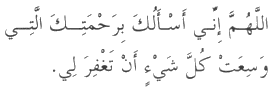
177. Allaahumma 'innee 'as'aluka birahmatikal-latee wasi'at kulla shay'in 'an taghfira lee.

O Allah, I ask You by Your mercy, which encompasses all things, that You forgive me.

Reference:
Ibn Majah 1/557 from a supplication of Abdullah bin 'Amr. Al-Hafidh graded it as good in his checking of An-Nawawi's Kitabul-'Athkdr. See Sharhul- Athkar 4/342.

Invocations before eating

When anyone of you begins eating, say:

178. Bismillaah.

With the Name of Allah.

And if you forget then, when you remember, say:

Bismillaahifee 'awwalihi wa 'aakhirihi.

With the Name of Allah, in the beginning and in the end.

Reference: Abu Dawud 3/347, At-Tirmithi 4/288. See Al- Albani's Sahih At-Tirmithi 2/167.

Whomever Allah has given food, should say:

179. Allaahumma baarik lanaafeehi wa 'at'imnaa khayranminhu.

O Allah, bless us in it and provide us with better than it.

Whomever Allah has given milk to drink, should say :

Allaahumma baarik lanaa feehi wa zidnaa minhu.

O Allah , bless us in it and give us more of it.

Reference: At-Tirmithi 5/506. See also Al-Albani, Sahih At-Tirmithi 3/158.

Invocations after eating

180. Alhamdu lillaahil-lathee 'at'amanee haathaa, wa razaqaneehi, min ghayri hawlin minnee wa laa quwwatin.

Praise is to Allah Who has given me this food and sustained me with it though I was unable to doit and powerless.

Reference: At-Tirmithi, Abu Dawud, and Ibn Majah. See also Al-Albani, Sahih At-Tirmithi 3/159.

181. Alhamdu lillaahi hamdan katheeran tayyiban mubaarakan feehi, ghayra [makfiyyin wa laa] muwadda'in, wa laa mustaghnan 'anhu Rabbanaa.

All praise is to Allah, praise in abundance, good and blessed . It cannot [be compensated for, nor can it] be left, nor can it be done without , our Lord.

Reference:
Al-Bukhari 6/214, At-Tirmithi 5/507.

A dinner guest's invocation for his host

182. Allaahumma baarik lahum feemaa razaqtahum, waghfir lahum warhamhum.

O Allah , bless them in what You have provided for them , and forgive them and have mercy on them.

Reference: Muslim 3/1615.

Invocation for someone who gives you drink or offers it to you

183. Allaahumma 'at'im man 'at'amanee wasqi man saqaanee.

O Allah , feed the one who has fed me and drink to the one who has given me drink.

Reference: Muslim 3/126.

Invocation for a family who invites you to break your fast with them

184. 'Aftara 'indakumus-saa'imoona, wa 'akala ta'aamakumul-'abraaru , wa sallat 'alaykumul-malaa'ikatu .

With you , those who are fasting have broken their fast, you have fed those who are righteous , and the angels recite their prayers upon you.

Reference: Abu Dawud 3/367, Ibn Majah 1/556, An-Nasa'i, 'Amalul-Yawm wal-Laylah 296-8. Al-Albani graded it authentic in Sahih Abu Dawud 2/730.

Invocation for someone who offers you food when you are fasting, which you decline.

185. When you are invited (to eat) then reply to the invitation. If you are fasting then invoke Allah's blessings (on your host), and if you are not fasting then eat.

Reference: Muslim 2/1054.

What to say when you are fasting and someone is rude to you

186. 'Inneesaa'imun, 'innee saa'imun.

I am fasting . I am fasting.

Reference: Al-Bukhari, cf. Al-Asqalani, Fathul-BAri 4/103, Muslim 2/806.

Invocation for when you see the first dates of the season

187. Allahumma baarik lanaa fee thamarinaa , wa baarik lanaa fee madeenatinaa wa baarik lanaa fee saa'inaa, wa baarik lanaa fee muddinaa.

O Allah , bless us in our dates and bless us in our town, bless us in our Sa' and in our Mudd.

Reference: Muslim 2/1000 (Sa' and Mudd are both dry measures used for agricultural produce by the Arabs in the Prophet's time. Of the two, the So.' was the larger measure.) (Translator)

Invocations:

Invocations for when the wind blow

166. Allaahumma 'innee 'as'aluka khayrahaa, wa 'a'oothu bika min sharrihaa.

O Allah , I ask You for the good of it and seek refuge in You against its evil.

Reference:
Abu Dawud 4/326, Ibn Majah 2/1228. See also Al-Albani, Sahih Ibn Mjjah 2/305

167. Allaahumma 'innee 'as'aluka kthayrahaa, wa khayra maa feehaa, wa khayra maa 'ursilat bihi wa a'oothu bika min sharrihaa, wa sharri maa feehaa, wa sharri maa 'ursilat bihi.

O Allah, I ask You for the good of it, for the good of what it contains , and for the good of what is sent with it . I seek refuge in You from the evil of it , from the evil of what it contains, and from the evil that is sent with it.

Reference:
Muslim 2/616, Al-Bukhari 4/76.

Invocation for when it thunders

168. Subhaanal-lathee yusabbihur-ra'du bihamdihi walmalaa'ikatu min kheefatihi.

Glory is to Him Whom thunder and angels glorify due to fear of Him.

Reference: Whenever Abdullah bin Zubair (RA) would hear thunder, he would abandon all conversation and say this supplication. See Al-Muwatta' 2/992. It was graded authentic by Al-Albani as a statement of Abdullah bin Zubayr only.

Some invocations for rain

169. Allaahumma 'asqinaa ghaythan mugheethan maree'an maree'an, naafi'an ghayradhaarrin, 'aajilan ghayra 'aajilin.

O Allah, shower upon us abundant rain, beneficial not harmful, swiftly and not delayed.

Reference: Abu Dawud 1/303. See also Al-Albani SahihAbu Dawud 1/216.

170. Allaahumma 'aghithnaa, Allaahumma 'aghithnaa, Allaahumma 'aghithnaa.

O Allah , send us rain . O Allah , send us rain . O Allah , send us rain.

Reference: Al-Bukhari 1/224, Muslim 2/613.

171. Allaahum-masqi 'ibaadaka, wa bahaa'imaka, wanshur rahmataka, wa 'ahyi baladakal-mayyita

O Allah , give water to Your slaves , and Your livestock , and spread Your mercy , and revive Your dead land.

Reference: Abu Dawud 1/305. Al-Albani graded it good in Sahih Abu Dawud 1/218.

Invocation for when it rains

172. Allaahumma sayyiban naafi'an

O Allah , (bring) beneficial rain clouds.

Reference: Al-Bukhari, cf. Al-Asqalani, Fathul-Bari 2/518.

Supplication after it rains

173. Mutirnaa bifadhlillaahi wa rahmatihi.

It has rained by the bounty of Allah and His mercy

Reference: Al-Bukhari 1/205, Muslim 1/83.

Invocation for the withholding of the rain

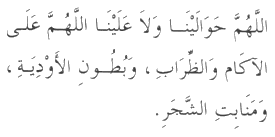
174. Allaahumma hawaalaynaa wa laa 'alaynaa. Allaahumma 'alal-'aakaami wadh-dhiraabi, wa butoonil-'awdiyati, wa manaabitish-shajari.

O Allah , let it pass us and not fall upon us , but upon the hills and mountains, and the center of the valleys , and upon the forested lands.

Reference: Al-Bukhari 1/224, Muslim 1/614